Aktivitas Antibakteri Ekstrak dan Fraksi Kulit Buah Jambu Biji (Psidium guajava L.) serta Analisis Bioautografi terhadap Pertumbuhan Staphylococcus aureus
Abstract
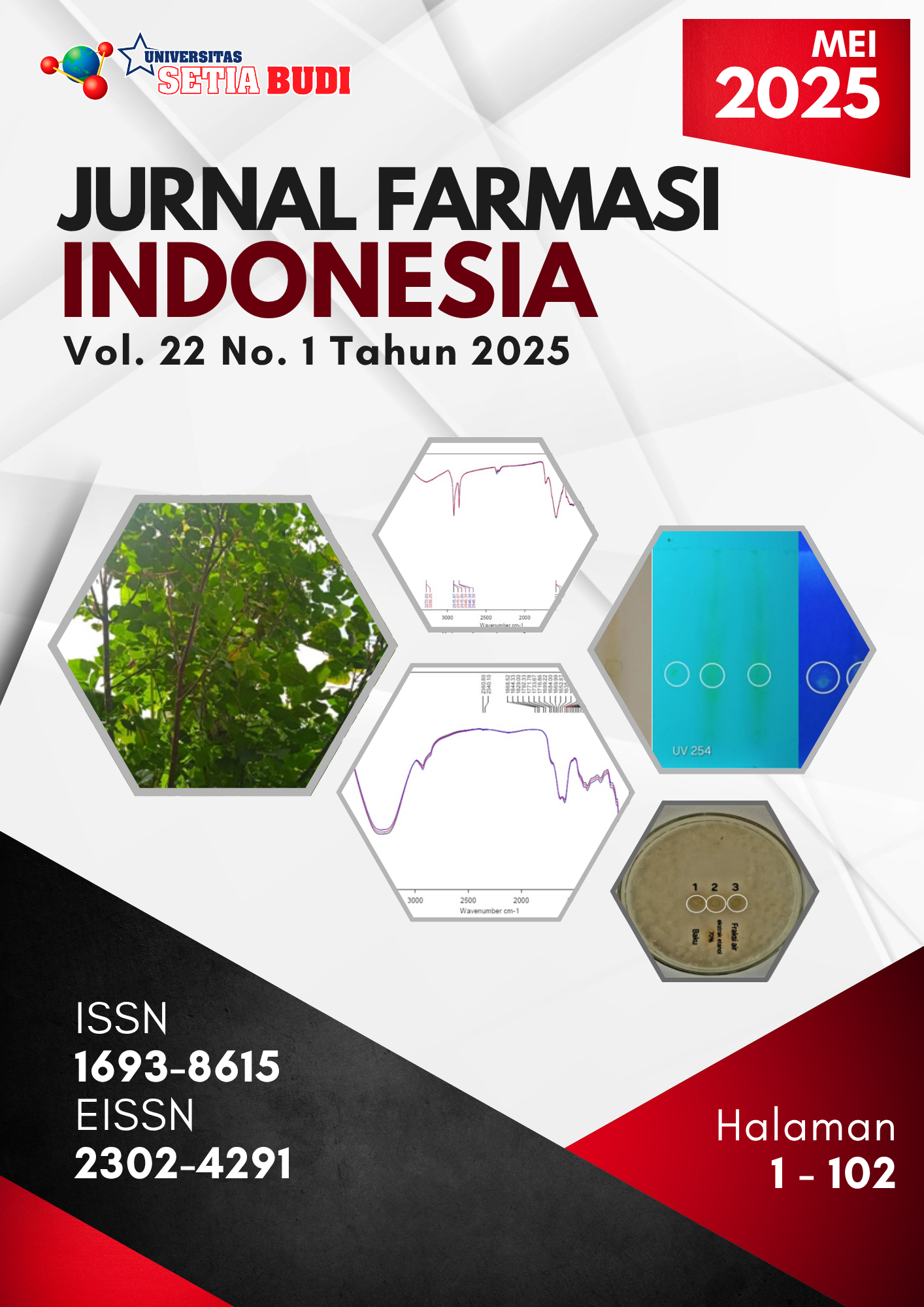
Guava (Psidium guajava L.) is a plant from the Myrtaceae family that is widely found in Indonesia. Guava skin contains flavonoids, alkaloids, saponins, tannins and terpenoids that have the potential to overcome various infections. This study aims to determine the antibacterial activity of guava skin extracts and fractions and to determine the group of compounds from the most active extract or fraction against the growth of Staphylococcus aureus using the bioautography method. Guava skin was extracted by the maceration method using 70% ethanol solvent, then fractionated using n-hexane, ethyl acetate, and water solvents to optimize the separation of substances. Antibacterial activity testing of guava fruit peel extract and fractions was done with concentrations of 8, 10, and 12%, positive control ciprofloxacin, and negative control DMSO 3%. Diffusion results were obtained from measuring the diameter of the inhibition zone around the disc paper. The results of the largest diameter were continued to determine the compound group of the most active extract or fraction through bioautography tests. The results showed that a concentration of 12% in the water fraction had the largest diameter of 16.55 mm which was included in the strong category. The water fraction that showed the most active antibacterial activity was then subjected to the bioautography method. The results obtained showed the presence of flavonoid compounds at Rf 0.34 with a diameter of 1.1 mm in the water fraction and 1.2 mm in the quercetin standard.
References
[2]Lumbantobing, H., Sartini, S., dan Rahmiati, R. (2022). Uji Aktivitas Antibakteri Ekstrak Daun Pepaya (Carica papaya) dan Ekstrak Kunyit Putih (Curcuma zedoaria) Terhadap Escherichia coli dan Staphylococcus epidermidis. Jurnal Ilmiah Biologi UMA (JIBIOMA), 4(1), 18-26. DOI: https://doi.org/10.31289/jibioma.v7i1.
[3]Akbar, S.A. (2019). Potensi Metabolit Sekunder Buah Jambu Biji (Psidium guajava L.) sebagai Inhibitor Korosi Rumah Lingkungan pada Besi. Chemical Engineering Research Articles Journal. 2(1). DOI:https://doi.org/10.25273/cheesa.v2i1.4014 .
[4]Abdelmalek, S., Enas, M., Abdelelah, A., and Reem, I.(2016). Peels of Psidium Guajava Fruit Prossess Antimicrobial Properties. The International Arabic Journal Of Antimikrobial Agents. Vol 6(31). DOI:https://doi.org/10.3823/791.
[5]Harahap, S.N., dan Nurbaity, S. (2021). Skrining Fitokimia Dari Senyawa Metabolit Sekunder Buah Jambu Biji Merah (Psidium guajava L.). Jurnal Pendidikan,Matematika dan Sains Universitas Nahdlatul Ulama, 5(2): 153-164. DOI:10.33541/edumatsains.v5i2.2204.
[6]Gunawan, A., Merkuria, K., dan Akhmad, M. (2021). Karakteristik Nata de Guava Peels dengan Variasi Konsentrasi Kulit Buah Jambu Biji (Psidium guajava L.) dan Lama Fermentasi. Jurnal Teknologi dan Industri Pangan UNISRI Surakarta, 6(2), 24-37. DOI:https://doi.org/10.33061/jitipari.v6i2.5150.
[7]Kartikawati, E., Syumillah, S., dan Widya, H. (2024). Uji Aktivitas Antibakteri dan Analisis KLT-Bioautografi Ekstrak Etanol Daun Situduh Langit (Erigeron sumatrensis Retz.) Terhadap Bakteri Escherichia coli. Jurnal Medika Farmaka, 2(1) : 165-175. DOI:10.33482/jmedfarm.v2i1.31.
[8]Larasati, M.D., Permatasari, D., dan Khasanah. (2023). Uji Aktivitas Antioksidan Ekstrak dan Fraksi Buah Jambu Biji Australia (Psidium Guajava L.) Metode DPPH. Journal of Educational Innovation and Health, 1(4), hal 185-202. Universitas Duta Bangsa. DOI: https://doi.org/10.55606/innovation.v1i4.1878.
[9]Rizki, S. A., Latief, M., Fitrianingsih, Rahman, dan Havizur. (2021). Uji Aktivitas Antibakteri Ekstrak, N-Heksan, Etil Astet Dan Etanol Daun Durian N (Durio zibethinus L.)Terhadap Bakteri Propionibacterium acnes dan Staphylococcus epidermidis. Special Issues: Jambi Medical And Health Sciences International Conference (JAMHESIC) 2021. Jambi Medical Journal, 4(1), pp. 442–457.
[10]Kemenkes RI. (2017). Materia Medika Indonesia Jilid VI. Jakarta : Rendemen Simplisia.
[11]Srivastava, V., & Nidhi, V. (2022). Antibacterial Properties of Psidium guajava Leaves, Fruit and Stems Against Various Pathogens In Methanolic and Ethanolic Extracts. The Pharma Innovation Journal. Department of Chemistry, D.A.V College,Kanpur, Uttar Pradesh, India 11(3) : 1817-1824.DOI:https://www.doi.org/10.22271/tpi.
[12]Rusli, N.A., Sri, W., Irwan., dan Nurfiddin. (2024). Isolasi dan Uji Aktivitas Antibakteri dari Bakteri Endofit Daun Matoa (Pometia pinnata J.R. dan G.Forst.) Terhadap Staphylococcus aureus dan Escherichia coli. Jurnal Mandala Pharmacon Indonesia (JMPI), 10(2), 562-572. DOI:https://doi.org/10.35311/jmpi.v10i2.590.
[13]Masita, T. E., Puspawati, N., & Rahmat Budi Nugroho. (2023). Identifikasi Daun Uji Sensitivitas Staphylococcus aureus Terhadap Antibiotik Dari Sampel Ulkus Pasien DM. Proceeding 3rd CIHAMS 2023 Universitas Setia Budi Surakarta, 8(2). Available at: https://cihams.setiabudi.ac.id/index.php/proceeding.
[14]Rusmiyati, N., Ayu, D., & Permatasari, I. (2023). Uji Aktivitas Antioksidan Ekstrak dan Fraksi n -Heksan , Etil asetat , dan Air Kulit Jambu Biji Australia ( Psidium guajava L .) Dengan Metode DPPH (1 , 1-Difenil-2-Pikrilhidrazil). Jurnal Politeknik Pratama, 1(4). DOI: https://doi.org/10.55606/detector.v1i4.2553.
[15]Paputungan, dkk. (2019). Aktivitas Antibakteri dan Analisis KLT-Bioautografi dari Fraksi Biji Kopi Robusta (Coffea canephora Pierre ex A.Froehner). Jurnal Pharmacon, 8(3), 516-524. DOI: https://doi.org/10.35799/pha.8.2019.29325.